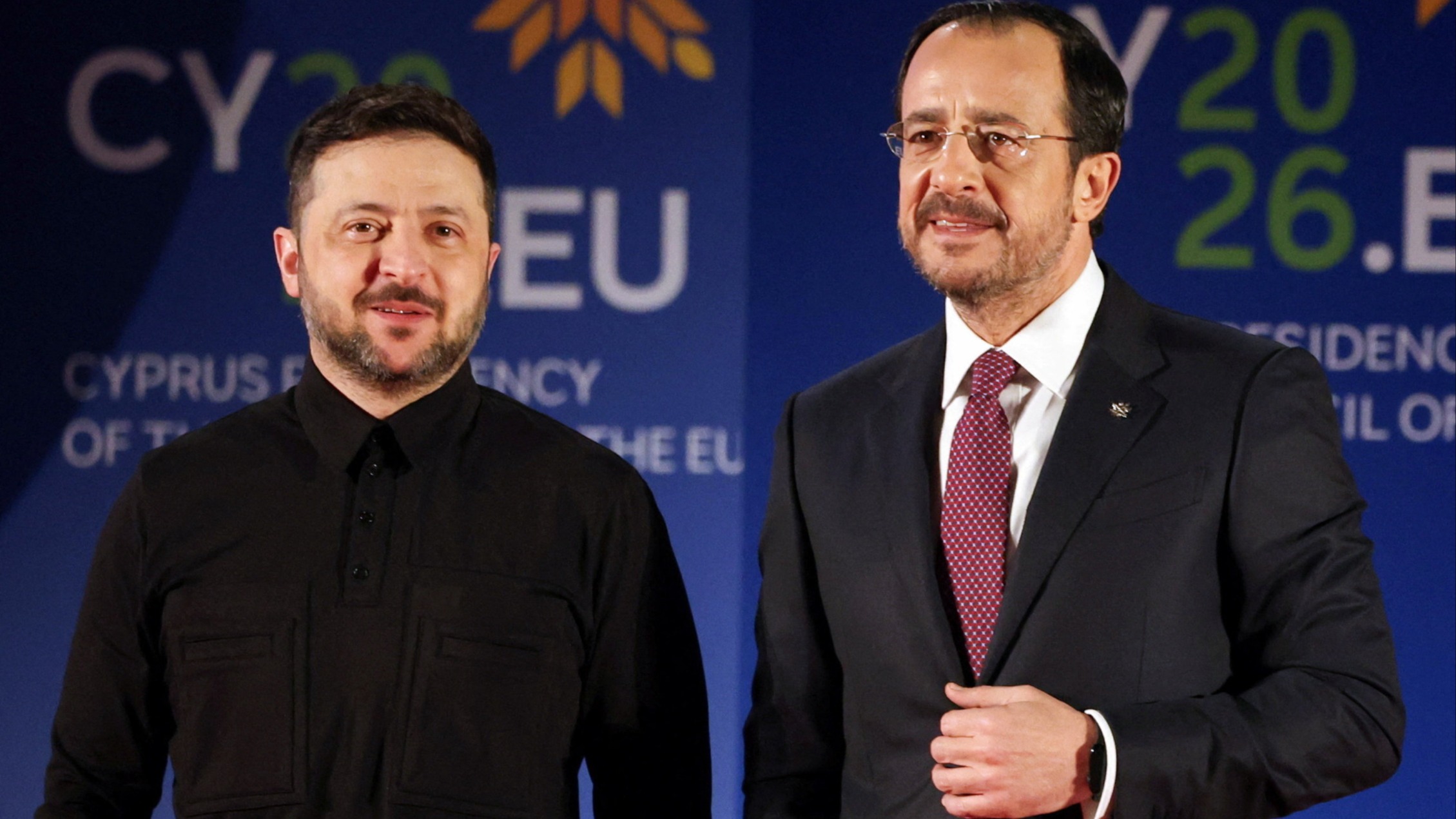
On January 7, 2026, the EU’s new Council Presidency was launched in Nicosia with a stage full of symbolism: Cyprus, the Union’s only divided member state, opening its term alongside the EU’s top institutional leaders and Ukraine’s president. It was a ceremony about more than rotating agendas. It was an explicit statement that enlargement is now being treated as a security instrument as much as a democratic or economic one. [Read more]
Moldova’s president Maia Sandu was present in Nicosia and, according to the source text provided by the reader, framed Moldova’s EU path in the same terms: enlargement means "more security and stability” and Moldova is ready for "the next steps” in accession. In the same context, Sandu met Volodymyr Zelensky, who publicly emphasized that Ukraine’s and Moldova’s EU paths must be coordinated, particularly around the simultaneous opening of the first negotiating "clusters". [Read more]
This is the moment where Moldova’s accession debate stops being an aspiration and becomes an engineering problem: not "Do we want Europe?” but "What exactly do we trade, what do we gain, and what do we risk losing - legally, politically, and economically - when accession is securitized and coupled to a regional war?”
"Next steps” is not a slogan anymore
Moldova is no longer at the "candidate status” stage. The formal accession negotiations were launched in June 2024, and the EU’s bilateral screening, where EU law is presented chapter by chapter and the candidate must prove readiness, was completed in September 2025. That is an administrative milestone, but it also marks a political transition: from rhetoric to compliance. [Read more]
When leaders talk about opening negotiating "clusters", they are talking about starting the binding work packages that will reshape institutions: judiciary, procurement, competition/state aid, regulatory independence, media rules, and the broader governance machinery needed to enforce EU standards. [Read more]
In that sense, the real question is not whether Moldova will "lose sovereignty” in the abstract: every member state shares sovereignty in defined areas, but whether Moldova’s institutional capacity and internal legitimacy are strong enough to survive that transfer without fragmenting the country.
Moldova’s sovereignty risk is different from other candidates’ risk
Sovereignty is not one thing. In Moldova’s case, the risk is amplified because several sovereignty layers are stressed at the same time: constitutional pre-commitment, regional legitimacy fractures, unresolved territorial issues, and a security environment that pushes alignment faster than institutional consolidation.
A practical map of the sovereignty-transfer channels
| Sovereignty layer | What EU accession operationally changes | Moldova-specific risk amplifier |
|---|---|---|
| Constitutional / legal | Domestic law must align with the acquis; core governance rules are locked into EU-compatible structures | The EU direction has been constitutionalized, making the trajectory harder to reverse through normal democratic alternation |
| Regulatory / policy | Competition policy, state aid rules, procurement discipline, regulator independence constrain ad-hoc domestic discretion | A small state with weaker institutions can experience "rule by compliance” and higher capture risk (domestic oligarchic or external) |
| Democratic / political | Conditionality drives reforms that can centralize power around enforcement institutions | In polarized environments, anti-corruption and vetting can be perceived (or used) as selective enforcement, eroding legitimacy |
| Security / neutrality | Security partnerships, defence support, and resilience integration pull the state toward a common strategic posture | A "security enlargement” frame compresses political space for neutrality in practice |
| Territorial / cohesion | Standards and central enforcement strengthen the centre’s control mechanisms | Gagauzia and Transnistria dynamics can turn "alignment” into a domestic conflict over autonomy |
This table is not anti-EU. It is simply the mechanics of accession, made more dangerous by Moldova’s particular internal geometry.
Constitutional pre-commitment: sovereignty is being bound in advance
In October 2024, Moldova held a constitutional referendum to anchor EU integration in the Constitution. The amended constitutional text was published afterward, and the referendum result was validated by the Constitutional Court. Reuters described it as a narrow "Yes” outcome and noted the decisive weight of votes from abroad. [Read more]
From a sovereignty-risk perspective, the key point is not the margin of victory but the institutional consequence: constitutional anchoring is designed to reduce the probability that a future government can change course. Constitution-level pre-commitment can be defended as strategic stability; it can also be criticized as reducing democratic reversibility in a society with deep regional disagreement.
Either way, this is sovereignty being redefined before membership arrives.
The legitimacy fracture is not theoretical: Gagauzia is a different country politically
If you want to understand why "sovereignty loss” resonates, you need to look at where Moldovans are not buying the story. In Gagauzia, preliminary CEC-referenced reporting indicated an overwhelming "No” vote, around 94.84% against and 5.16% for, making it the most concentrated rejection of the EU constitutional change in the country. [Read more]
This matters because accession is not only a negotiation with Brussels; it is a long internal campaign of compliance that requires social consent. When a region perceives "Europe” as "centralization” (or worse, as a pathway to cultural dilution or geopolitical absorption), the accession apparatus becomes a pressure machine that can either integrate the region through tangible benefits, or harden its refusal into a permanent political fault line.
Even pro-EU reporting has had to acknowledge this resistance and the need to "reassure” eurosceptic regions such as Comrat. [Read more]
Security enlargement changes the meaning of accession
The Nicosia ceremony’s subtext was security, and Moldova’s trajectory already reflects that. In May 2024, Moldova became the first country to sign a Security and Defence Partnership with the EU, explicitly structured around resilience and joint responses to shared security challenges. [Read more]
Add to this the hard realities of energy vulnerability. The EU has supported Moldova with energy-security plans and funding packages aimed at reducing dependence on Russian supplies, including support relevant to Transnistria’s humanitarian exposure when energy flows are disrupted. [Read more]
These measures can be read as protection. They can also be read as a new form of dependency: if energy stability and defence capability increasingly flow through EU mechanisms, Moldova’s "sovereign choice” becomes structurally conditioned by the need to remain inside the supporting architecture. In small states, dependence is not only financial: it is political.
"Coordinating” accession with Ukraine: opportunity, but also coupling risk
Zelensky’s public line after meeting Sandu, coordinate the common path; open the first clusters simultaneously; deepen trade, energy and security cooperation; strengthen trilateral cooperation with Romania has been reported both by Ukraine’s presidency and by Moldovan state media.
Coordination can make Moldova harder to isolate and easier to defend diplomatically. But it also creates a coupling risk: Moldova’s negotiating tempo, messaging, and even reform prioritization can be pulled into the gravitational field of Ukraine’s war-driven agenda and the EU’s security logic.
When accession becomes a theatre of deterrence, domestic governance can start to serve external signalling needs—, ometimes at the expense of internal cohesion.
The governance paradox: reforms can strengthen the state and still weaken sovereignty
A common misunderstanding in "pro vs anti EU” debates is that sovereignty equals maximal discretion. For fragile states, sovereignty is often the opposite: the ability to enforce rules consistently, resist capture, and remain governable without permanent emergency politics.
Accession reforms can strengthen that sovereignty by building institutions. But there is a paradox: conditionality-driven state-building can also centralize power around enforcement systems, creating legitimacy stress if large parts of society interpret reforms as externally imposed or selectively applied. Election observation material from ODIHR emphasizes that Moldova’s 2024 electoral environment faced concerns about illicit foreign interference and disinformation, while also noting issues such as uneven campaign conditions. [Read more]
The point here is not to relativize interference. It is to state the core risk: a securitized accession process encourages "hard” governance tools: anti-corruption, anti-vote-buying, media regulation, foreign influence countermeasures. If these tools are not designed with strong checks and transparency, they can produce exactly what sovereignty critics fear: a state that looks stronger on paper but becomes more brittle politically.
Even institutions supportive of resilience warn against overly restrictive or hasty measures in the context of foreign interference and democratic protection. [Read more]
What a sovereignty-aware accession strategy would look like
A serious state does not enter accession with blind faith; it enters with a negotiated understanding of its own red lines and internal vulnerabilities. For Moldova, the sovereignty-aware strategy is not "stop accession", but "don’t turn accession into a domestic rupture".
That requires three disciplines.
First, constitutional clarity: if EU integration is constitutionally anchored, then the Constitution should also articulate the non-negotiables of democratic pluralism, minority protections, and autonomy governance, so that EU alignment does not become an excuse for domestic overreach.
Second, decentralized legitimacy: Moldova needs a parallel "internal accession” effort, especially in regions like Gagauzia, focused on economic dignity, language and cultural respect, and practical benefits. If accession is experienced as punishment or humiliation, the sovereignty backlash will not disappear; it will metastasize.
Third, security without permanent emergency: security partnerships and energy integration are necessary, but they should come with transparent governance, parliamentary scrutiny, and anti-capture safeguards. Otherwise, Moldova will trade one type of dependency for another, while calling it sovereignty.
A note on information operations
Sovereignty fears are real. They are also exploitable. Moldova’s geopolitical position makes it a natural target for narratives that mix legitimate concerns (identity, autonomy, neutrality, price shocks) with manipulative conclusions ("you will be annexed", "you will be erased", "you have no choice”). The best defence is not censorship; it is institutional trust: transparent policy, credible oversight, and the ability to separate hard facts from emotional engineering.